


Tape one end of the narrow tubing on to one end of the plastic bottle. Make sure to leave at least 1cm hanging over the end.
Let's Experiment
Try to build an Archimedes screw at home or in the classroom. Collect your materials listed below and follow 6 simple steps to conduct your own experiment.
Estimated time 30min.
How to build
How to build
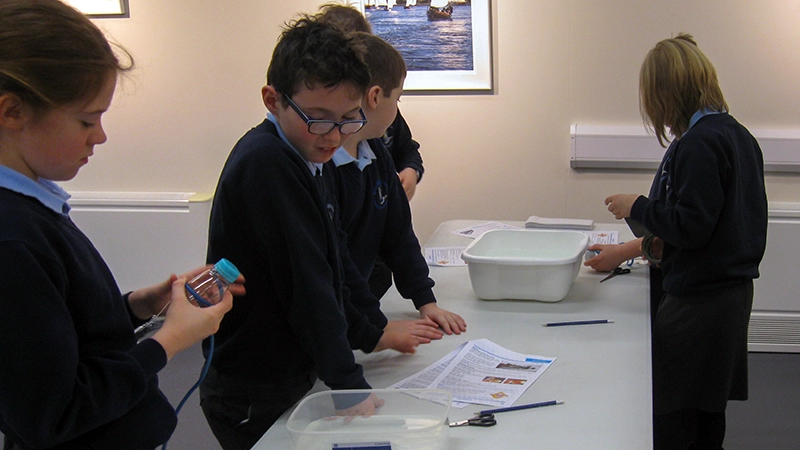
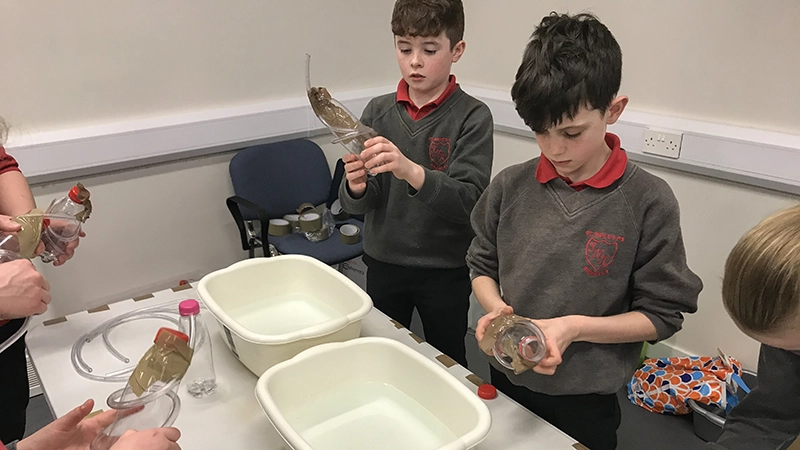
Carefully wrap the tubing around the bottle until the reach the other end. You will need to tape down the tubing at intervals as you go along.
Prepare the bowls:
Mix a few drops of red or blue food colouring with one cup of water in one of the bowls. This makes the water easier to see.
Place the other empty bowl on a book (or any object) to raise it up. Place it where it will catch the water which comes out the top of the tube.
Place one end of the screw in the bowl of coloured water, with the other end resting on the higher bowl.
Turn the screw slowly and water should go into the tube, up to the top of the tube and fall into the upper bowl.
Does it make any difference when you turn the screw in reverse?
Troubleshooting
Q: My screw pump is not picking up any water when I turn it. What am I doing wrong?
A: Try readjusting your pump. It will need to be positioned in a way so that the entire opening of the tubing is underwater when you turn it. If that doesn’t help, try turning the pump the other direction.
Q: How high should the second bowl be raised off the table?
A: You can use any flat object you want, but the height you are aiming to reach between 1 and 2 inches. A thick book or piece of wood will work fine.
Math Activity
How much water can be moved from the lower bowl to the higher bowl in 2 minutes?
- Calculate the rate i.e. the number of millimetres per minute.
- Time how long it takes to move half a cup of water from the lower bowl to the higher bowl.
- Work out how many turns it takes to move half a cup of water up to the top bowl. Use a permanent marker to mark on top of the tubing. When this mark comes round to the top again, that counts as one turn.
Follow-up Activities
Investigate whether the following makes a difference to the rate at which the water comes out of the top of the screw:
- The length of the screw
- The diameter of the tubing
- The number of turns of the tubing (if turned too fast the water does not have time to get into the tubing)
- The angle at which the screw is placed in the water